


 Posts
Posts


Several years ago, in a drunken conversation with a friend who wanted to know why Tokyo had such a pull on me, I told her that I had, for years, felt that I was meant to be here for the "Big One" — that whether I lived or died, the quake that is meant to destroy Tokyo is something I needed to see through. I can't explain why I felt that way. Or why I still feel it.
A year ago today, though, part of that fatalistic sense of destiny evaporated.
At 2:46pm on March 11, 2011, when the building I was working in began to shudder, I felt the kind of fear that causes a person to lose all sense of reality. The thoughts rushing through my mind were a mix of disbelief, terror, and wonder. Was this what I had been waiting for all these years? Was everything about to crumble around me? As I ran down the fire escape onto the street, I had truly bizarre flashes of people on similar stairs in New York on Sept. 11, 2001 — that event being such a part of global consciousness. Was this building about to fall down upon me?
Yet, as shit-scared as I was, I can say now, that I lost my fear of earthquakes that day. I realized that if I am to be anywhere in the world during a quake of that magnitude, or larger, then inside a modern building in Tokyo is where I want to be. The quake-proofing works. Next time a quake hits I won't run. That is, not until the tsunami alarms sound.
For, while I lost one fear a year ago, I gained another. Nothing now scares me more than a tsunami.
I have seen first-hand the destruction wrought by the wave that day, and I can't shake those images from my mind. Even now as I walk through Tokyo I often stop to think, "How far am I from Tokyo Bay?"
The "Big One" will come to Tokyo, and I will probably be here. But it doesn't scare me as much anymore — as long as I can get to high ground soon after.
Today my thoughts are with all the people swallowed up by the March 11 tsunami, and my heart goes out to the survivors left behind.
11/03/2012
Remembering March 11

23/05/2011
Volunteering in the tsunami zone

It's been over a year since I wrote anything here. I guess I felt that I'd nothing much to say. But the March 11 megaquake and tsunami in eastern Japan was, to say the least, a life changing experience. Not that my day to day life has changed all that much, and I was never really in any harm, but the way I view life has changed. When I had the choice to leave Tokyo I realized that my home now is here, so there never really was any question of leaving. Instead, I decided to lend a hand and joined the many people volunteering in the tsunami zone. Below is an article/journal I wrote for The Japan Times newspaper about my week as a volunteer.
A volunteer's journal of hope for Tohoku
Many willing hands in organized groups are aiding
in the massive post-March 11 clean-up
By ANDREW LEE
Special to The Japan Times
When the magnitude 9 megaquake hit northeastern Japan in the early afternoon of Friday, March 11, I was at work in The Japan Times office some 250 km to the south in Tokyo.
As the building here shook, I ran down the emergency stairs fearing for my life and then stood outside watching the high-rises around us swaying. I was absolutely terrified — and it didn't get any better when the tsunami warning screeched out of speakers in the neighborhood.
After running back inside — because the JT office is at sea level on Tokyo Bay — I found the newsroom was in chaos, with quake alarms sounding constantly on people's cellphones and the radio as the first aftershocks started to rattle the country, and TVs all showing horrific live images of the tsunami as our reporters scrambled to make sense of what was happening and get the story out.
I admit I was so scared that I left work early to head home on foot, as all public transport seemed to be halted.
In the days that followed, as the full impact of what had happened in the Tohoku region began to be revealed, I felt a little ashamed of my behavior. I had never actually been in any danger in Tokyo, and as I saw and heard what the people up in the tsunami zone were going through I wanted to help in any way I could.
Then, after a colleague wrote a story about the nonprofit Peace Boat organization's disaster-relief work in the devastated coastal city of Ishinomaki in Miyagi Prefecture, I decided that I would take a week off work and volunteer. After attending a couple of orientation meetings, I was told I could join a Peace Boat group leaving for Tohoku on Friday, April 22.
So, six weeks to the day after the quake hit, I boarded a Peace Boat bus in Tokyo, loaded with everything I would need to survive a week in the disaster zone — camping equipment, seven days' food and water, a dust mask, heavy-duty rubber gloves and boots, a helmet and goggles. We arrived on a rainy Saturday morning and set up camp in the grounds of Ishinomaki Senshu University university — but the real work didn't start until Sunday.
What follows is an only slightly edited copy of the diary I kept at the time, fastidiously keying each day's experiences into my iPhone before curling up exhausted in my sleeping bag.
17/04/2010
Why I like Japan is a bit odd.
It is quiet. I know how that sounds. Silent? It's not exactly the first thought that comes to mind when you think of Japan, especially of Tokyo. With its constant din of announcements, crowded streets, packed trains, jingles, chimes, and high school girls squealing "kawaii". But it is. Quiet.
Ride a packed rush hour train and you'll understand. Every morning I squeeze onto the same train, the 8:37, or perhaps the 8:42 if I'm late. And it is a squeeze. There really are men with white gloves politely cramming you inside. Sometimes you are compressed so hard into the train carriage that your spine pops because someone's shoulder is pushing into your back. Especially if you're tall.
But once the doors have closed and your locked into that space. It's silent. Nobody talks. Each individual unit of humanity in there exists as a bubble of isolation. Heads wrapped in the data emitted from mobile phone screens, or surrounded by the world inside game devices, manga, and books, or within the soundscape of their headphones. Everyone withdraws into themselves. But we're all connected, touching. In fact, this is probably the most intimate many of us will be with another human that day. Yet each of us is quiet. And it's peaceful. Safe. Nice. Comforting. There are no loud people talking on their phones, subjecting all around them to their inane apparently one-sided conversations. No one is telling the person next to them to just stop fucking pushing. No one is angry. No one is scared. It's fearless. It's polite. It's a little shy. It's a mood that suits me. Because I'm a fairly quiet guy. And I belong here.
09/09/2009
Remembering Emil Goh

I last met my friend Emil in Tokyo on 15th February 2008, when he was making a visa run from Seoul were he lived. I'd arranged to meet him outside the Starbucks at Scramble Crossing in front of Shibuya station. I remember spotting him in the crowd giving me a wave and a smile as he crossed the road. He was wearing jeans and a black V-necked sweater over a white collared shirt. His hair was longer than it had been when we knew each in Sydney. But that had been several years before. It was great to see him and we gave each other a big hug.
I remember he told me he'd been making trips to update his visa every three months for the many years he'd been living in Seoul. I thought that showed how determined he was to keep working there as an artist. He said he usually went to Hong Kong but had left it too late this time and could only get a ticket to Tokyo. I'm glad he did, because I got to see him. He laughed and told me he reckoned the customs guys in Seoul never gave him a hard time because they thought he was a second generation Korean who kept coming back to visit his relatives. He wasn't. He was Malaysian. I think we once talked about how I lived in Malaysia as a kid. I wish I could remember more about that conversation, I think he knew the school I went to, but that may have been someone else.
When we met in Tokyo he was determined to go to a ramen (noodle) restaurant he had read about on the web. It was late and I remember standing with him outside the closed Apple store in Shibuya, he was able to get WiFi on his iPhone and looked up the address on Google maps. It was just down the street, Ichi-Ban Ramen, I think it's called. I'd never heard of the place even though I live here. Each person sits in a private, box-like cubicle and orders their noodles anonymously. The servers are hidden behind curtains. It was typical of Emil to track something fun like that down and share it. We leant out from our cubicles and between slurps of ramen and sips of beer we spoke of the things we'd been doing over the years. His work as an artist and lecturer sounded fascinating, and I swore I would go visit him in Seoul.
I remember after we ate ramen we headed to Combine in Naka Meguro where we met a few people I know for drinks. I wish I could remember more, but the evening kind of fades into the distance after that. I'm sure Emil would have remembered. I wish I could ask him.
Sadly Emil died the other day in Seoul. Much too young and much too soon. As a mutual friend said, Emil was a doer. I hope that is something I can learn from him.
Rest in Peace Emil, I will miss you.
More about Emil:
Emil's OzArt profile
Emil's page in the Face to Face exhibit
An interview with Emil about his CyWorld project
14/06/2009
Otaku Encyclopedia Launch Party

From left: Akiyama Masumi (designer), Asaki Katsuhide (photographer), Patrick W. Galbraith (author), Andrew Lee (editor), and Akashiro Miyu (illustrator).
We had a great turn out for the launch party of The Otaku Encyclopedia last Friday. The party was held at a maid café in Akihabara, called Café Schatzkiste. The poor maids were only expecting around thirty people to show up so didn't know what hit them when the hordes of otaku-bloggers, media, and minor celebrities started to poor through the doors. At least fifty people must have shown up and the place was packed.
I managed to convince Patrick to show up in costume, and it was great to finally have the team who made the book together in one room. Akashiro Miyu, who created "Moé-chan" the book's cute character, made a special trip from Osaka, and it was great to finally meet her. Asaki, who took most of the portraits in the book, and Akiyama Masumi who designed it, were also there.
Some of the other people who showed up included Danny Choo, who showed up in his Stormtrooper outfit, and Anno Haruna the game idol who is interviewed in the book.
Quite a few people were snapping away throughout the event and you can see their pix here:
Photos by Steven Nagata
Photos by Pietro Zuco
Photos by Jonny Li
And here's what people have said about the event or the book on other blogs so far:
Danny Choo
Anno Haruna (she's the game idol interviewed on page 86 of the book - Japanese only):
Paul Papadimitriou
Zuko
The Western World
Kotaku
Akiba blog (Japanese only)
Hobby Blog
Anime Vice
09/06/2009
The Otaku Encyclopedia!

I am finally emerging from under the mountain of moé* I have been buried under for the past six months, to tell you that finally The Otaku Encyclopedia is on sale in Japan! This photo of it on display at Kinokunia in Shinjuku was sent to me just now (thanks Haru!) proving that the book has gone on sale about a week earlier than I'd been told it would be! I guess I better hurry up with the website design... but until then you can see what Danny Choo (see previous posts) had to say about the book.
* moé is the latest otaku buzz word, and basically means to get all hot and sweaty over some budding 2D cutie. But you can buy the book for a better definition ;)
17/01/2009
Afro Samurai vs Danny Choo

I had a fun night at Danny Choo's place the other evening when he invited me over to have dinner with our mutual friend Takashi "Bob" Okazaki, and a few of his Afro Samurai colleagues. Turned out to be quite the otaku gathering, with Bob dressing up as Darth Vader and all us lads going gaga over Danny's figure collection. I'm not sure what kind of expression I was trying to pull in this photo, but you've gotta at least try and look a bit tough when you're standing next to Vader! In the photo are:
From left to right:
Fuminori Kizaki (Director of Afro Samurai)
Mrs Bob Vader, Minna (hiding in Vader's cloak!)
Danny Choo
Takashi Okazaki (Original creator of Afro Samurai) as Darth Vader
Myself
Hiroya Iijima (Afro Samurai Character Design/Animation Director)
Will Feng
You can see more pix over at dannychoo.com
13/01/2009
Seijin no hi

Yesterday was the Seijin no hi (Coming of Age Day) holiday in Japan. It was beautiful weather and I headed out with my new mate Danny Choo to take a few pix for his blog. The plan was to get photos of him in his Storm Trooper costume with as many cute twenty-year-old girls we could grab.
The official age for adults in Japan is twenty and on this day each year, young men and women gather at their local city halls (or somewhere else if the hall is too small) to be officially welcomed into adulthood. The new grown-ups dress in their best formal wear, which for girls means beautiful kimonos, called furisode, and fluffy fur stoles. This style of kimono is distinctive because of the bright colours and long flowing sleeves that signify a girl is both an adult and single, which is a handy thing to know ;) 
Danny and I visited the CC Lemon Hall in Shibuya where gaggles of giggling Shibuya gals wore a sensational mix of their normal "gyaru" hair-styles, makeup and traditional kimonos. The addition of "decora" accessories and outrageous nail fashion completed the look.
03/12/2008
Arcade Mania! on Japanese TV!

I woke up early this morning to watch Brian Ashcraft on NTV's morning show "Zoom in Super." He was interviewed a few days ago about Arcade Mania! and all of us involved in the book have been dying to see how it'd turn out. And it was fantastic!
The show had basically decided to do the story because they'd seen Arcade Mania!, and ran a 10 minute segment about foreign tourists flocking to Japanese game centres. They spoke to lots of people about what they thought of the arcades and opened with a shot of the book's cover. Then they spoke to Brian (who I gotta say came across really well despite being scared shitless) and showed the book again inside and out. It was really nice to see the book getting such good exposure.
Here are a few more pix Brian and I took off the screen: 


22/11/2008
Arcade Mania! vs Pingmag
I swear it's a total coincidence that the last post was also about something up on PingMag. No, really! If I wasn't so lazy I might have posted something in between, but no... Anyway, Ping had nice long chat with Brian Ashcraft the author of Arcade Mania! Hopefully this is the start of lots of press on the book and we'll sell lots of copies!
Read the interview here...
10/11/2008
Kabukicho vs Pingmag
I recently interviewed Max Hodges of White Rabbit press about his new Tokyo Realtime: Kabukicho audio guide tour. He's a pretty crazy guy so it's kind of a shame so much of what we spoke about was "off the record"! But you can read (the rather heavily edited) version live on Pingmag now.
27/10/2008
More JSG Rock
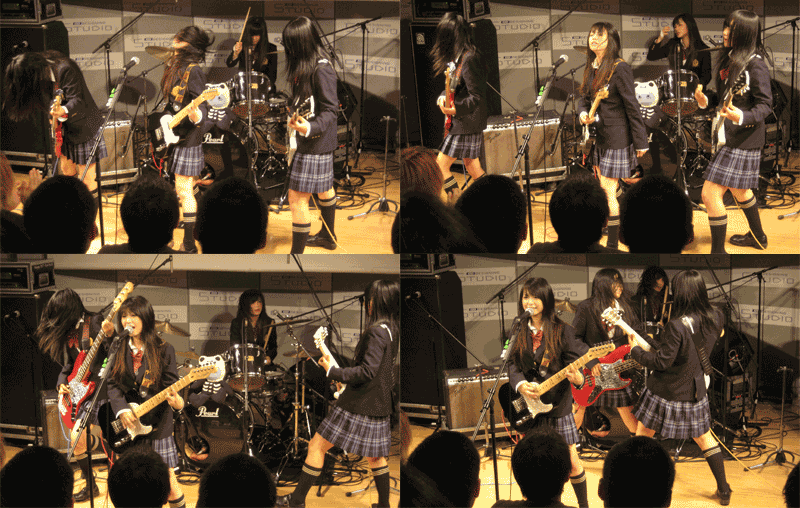
"Rock'n'Roll High School" by the Ramones blasts from the speakers as four Japanese girls in high-school uniform come on stage. It couldn't be a more perfect song to introduce this band to the waiting press.
Scandal are young, sexy, and have a gimmick that may just carry them to international stardom. As I've pointed out before, there is something magnetic about metal performed by Japanese high-school girls wielding guitars like pros. Maybe it's because long black hair is made for head banging, or maybe it's the tartan skirts? But the school uniform and rock formula is something that works. Just ask Angus Young from AC/DC, and he's nowhere near as sexy. Comparisons to the band in the film Linda Linda Linda are also inevitable. But Scandal are the real deal, they got their start playing live on the streets of Osaka, and three of the girls are actually still in high-school; the forth, the lead singer Haruna, is only 20. They're fresh, young and really look like they enjoy what they're doing. They play like they love rock and with their 70s rock hair, and Fender and Gibson guitars, they have all the trappings of a rock band, including lots of groupies... male groupies.
Their fans are a bit of a worry actually. At the moment they're the same kind of awkward guys that like to dance along with syrupy Akihabara street idols. They're very uncool, and an association with them may be to the bands detriment. It's easy to see why otaku are attracted. Schoolgirl uniforms are a major fetish for these guys, but unlike the glut of so called "idols" out there catering to the otaku dollar, these girls actually have talent. They can really play, and really do rock out live.

But Scandal is going to have to break free from the otaku ghetto if they are going to be taken seriously. They may need to rock even harder to release themselves from their current fan base. It may be overseas that they find their true rock creds by following in the footsteps of Japanese bands like Shonen Knife.
They also need a better producer. These girls are way better live than they are on their CD, which has been mixed as if they were light weight J-pop stars. It totally caters for the otaku audience, but when they play live their sound is much bigger and more raw. It's a shame that the energy of their live show is diluted on the CD. It could be much better, and if they are to succeed overseas they need better producer, one who knows how to deal with rock.
Ditch the otaku fans I say and get the Indy fans behind you. Scandal have already played in the States and may return to play at the South by Southwest festival next year. Keep an eye out for them.
Here's their latest single, "Doll":
17/10/2008
Bome vs Docomodake
I caught a couple of exhibitions last week, one by chance and the other less random; but both were linked by the fact art in Japan these days often has its roots deeply buried in corporate-pop-culture. We probably we have Takashi Murakami to thank for this. Him and his grand Superflat theory—that Japanese don't traditionally make distinctions between "high" and "low" art—have sure made it easier for artists and corporations to come together and produce art for the masses. Populist, fun art that seems easy to understand. But art that doesn't challenge the viewer too much. Branded, corporate art that sells for a fortune; but with copies mass produced to sell in toy stores. Art that's given away with a mobile phone. It's art for everyone, but no one in particular.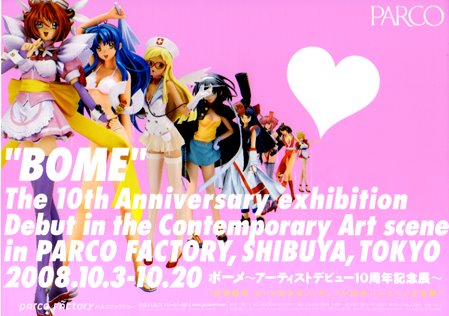
I stumbled across the first exhibition in Shibuya when I noticed a bright pink poster advertising a show by BOME—who can most simply be described as a sculptor; a very otaku sculptor. In Japan Bome is best known for his sexy three dimensional figurines of anime-style girls, including the Monseiur BOME series of collectible figurines from Kaiyaido. These are sexy dolls for pervy boys; of big-busted babes with ridiculously long legs. They're the 6 inch girlfriends of otaku (to quote Patrick Maccias). And they seem almost, how can I put this? Possible.
Bome's skill is taking the absurd proportions of women in the two-dimensional world of anime and manga, and transforming them into glorious, eye-popping 3D. This is why he has so many fans; because he has overcome what otaku call the "three-dimensional contradiction" that the girls who exist on the pages of manga could not possibly exist in the real world. The weight of their breasts alone would mean the poor girls' backs would give out! But somehow, Bome's figures pull it off and the illusion of possibility is what makes these dolls such a tease. This skill is also what caught Takashi Mukrakami's eye many years ago.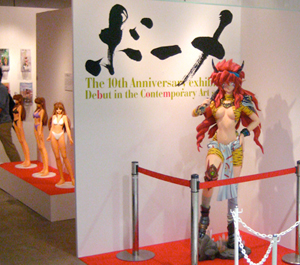
With the help of Murakami, Bome's work has managed to emerge from the dark geeky ghetto of figure-collecting otaku into the glare of the international art world. And ever since 2003 when his 1997 collaboration with Murakami—a sculpture called "Miss ko2 (Project ko2)"— fetched US$567,500, the highest price ever paid for a piece of contemporary Japanese art at the time, Bome has been known overseas as an artist to keep an eye on. The show at Parco Factory is billed as the 10th anniversary of the artist's debut into the contemporary art scene, but it's essentially a show for otaku. Many of Bomes original figures are on display, and from his most early work in the 1980's to the most recent work it's fascinating to see the development of his technique. There are videos showing interviews with him and there's a detailed, step-by-step display of how he makes his dolls. But the best part of the whole exhibition—and the thing that brings all the high-falutin talk of his art world connections back down to earth— is that you can buy the mass produced versions of his figures in the gift shop, for about 4000 yen each.
The second show I went to see was a much more blatant corporate art show, but one that ironically had art of a more traditional taste, and very different flavour. "How to cook a Docomodake" is a collection of work by sixteen artists who were invited my the mobile phone company NTT Docomo to produce art that was inspired by the company mascot, a mushroom called the Docomodake. The exhibition first showed in October 2007 in New York, and was a very clever way for Docomo—who are not at all well known in the US—to introduce both their brand and their popular mascot. In Tokyo the character needed no introduction and the show was still packed when I went to see it on the closing day. 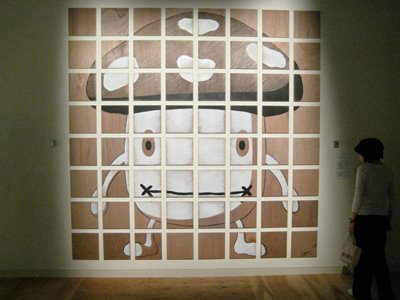
Essentially all the artists involved had deconstructed the well known character and presented it in their own way. Rika Eguchi, presented the Docomodake served up as if cooked in different ways, grilled, sliced, diced and rather over-cooked. This work was the most "cute" of all the work there, but not the best. My personal favourites were the detailed, psychedelic, pencil drawing by KYOTARO entitled "The Sleeping Forest" and of course "Yokai - Japanese Ghost - Dokomodake" by MUSTONE (pictured above). I also really liked the jacket and skirt by ANREALAGE, who has taken apart hundreds of stuffed Docomodake toys, including the small "screen-cleaner" versions that hang off people's mobile phones, and sewn them together to make his patchwork fashion (below).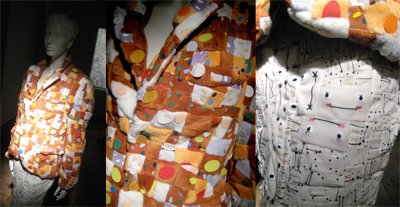
Both these exhibitions could be criticised by a more serious art critic for being shallow, and vapid extensions of a post-modern society that doesn't quite know how to stop feeding upon its own pop offspring and start producing meaningful art again. But I liked it.
"BOME" The 10th Anniversary exhibition Debut in the Contemporary Art scene in PARCO FACTORY, SHIBUYA, TOKYO runs until October 20th, 2008
How to cook a Docomodake was at the Intercommunication Center at Tokyo Opera City but ended on October 13th, 2008
01/10/2008
Alone in Shibuya
I found a good place to sit and watch. From a seat near this bar's window, I can see Shibuya passing me by. Opposite me there's an Excelsior Caffé that I know, from personal experience—and a somewhat obsessional love of good coffee—fails to excel in café. Beside that there's an entrance to a basement bar that's advertising cheap beer. A black guy stands there, waiting for customers, and occasionally breaks into dance. Break-dancing. Moon-walking-robot-style; seriously old-school. In front of him, on the sidewalk, are three men, two black, one Japanese, and it sure looks like they are passing a blunt. The police Koban is about one hundred metres away. Next to the cheap-beer-hip-hop bar is a Zara, and girls walk by looking at the mannequins in the window. It's raining, which is when I Iove Shibuya best; wet—neon reflecting in the puddles on the street. Umbrellas up, shielding the faces of all the girls with great legs, leaving me to wonder just how wonderfully gorgeous they are. Reflected in the second floor window of the Excelsior Caffé is a Big Echo karaoke place—a big reflected echo. Other signs add an expressionistic chaos of colour to the slick wet asphalt; the "Italian Tomato Cafe Jr.," and the "Curry House CoCo" send an aromatic mixture of curry and garlic into the damp air. A girl posts a letter in a tomato-red mail box as couples walk by, and the two girls sitting next to me light two more cigarettes. They are talking about their friend, who "is so beautiful she looks like a foreigner," and I wonder about the different eye's of the beholder, as mine scan the girls out the window, and the beautiful ones are beautiful maybe because they are foreign, to me. A white guy wearing a red-and-white shell-suit is lingering near the hip-cheap-hops bar; red baseball hat worn backwards, he's trying so hard to get "down" with the black guys clustered there. He's weedy, small, dangerous in his intense desire and looks like a dealer, an East London dealer, twitching, nervous and keen. He tries to lure passing girls with his imagined ghetto charm and fails. Now he's leaning alone against a wall. Now he's alone beneath a clear umbrella. Perhaps he works cheap for the hip-hop beer. Opposite him is a smooth black gentleman in a suit-and-tie and the contrast between the two is culturally amusing. The smooth dude is emailing someone on his mobile. The girls next to me have gone. And my glass is empty.
26/09/2008
Arcade Mania! launch party

A quick reminder that the launch of Arcade Mania! is tomorrow night (Saturday 27th) so if any of you who happen to read this blog also happen to be in Tokyo, please come along!
Here is a link to the invitation on Kotaku
20/09/2008
Itasha
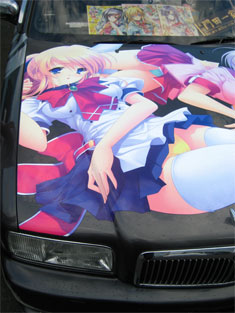
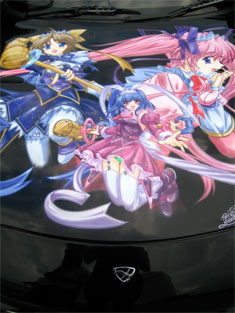
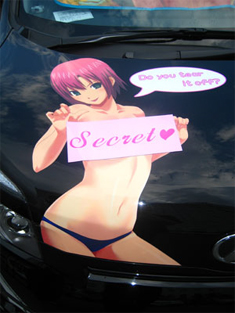
I went to COMIKE about a month ago, along with about 500 thousand others, and it always amazes me just how massive this amateur comic market is. I've been four or five times now and the manga on offer this time were the usual piles of comic-porn. Naked manga honeys assaulted and exalted by a mass of sweaty otaku. This shocked, and to be honest kind of titillated me the first time I went, but it now seems boring, and a little sad. It never seems to change. The same drawing styles. The same themes. The same cum-covered girls fighting off the same invisible, censored, phallic-somethings. And it is still mostly young women drawing and buying this stuff—which is the one thing that does still raise my eye-brows.
But in the car park this summer were a group of otaku I hadn't seem before. Standing proudly beside their cars these guys reminded me of rev-heads back home in the 1970s, who declared their machismo by airbrushing naked-chicks on their muscle-cars. The modern Japanese approach however is to splash hot-anime-babes across the bonnet to display just how much "moe" you feel.
Now moe (a key term for otaku, and pronounced "mo-ay", like Moet champagne ), is kind of a hard concept to grasp. But basically, imagine that you seriously have the hots for a girl — probably a young teen girl — and that you are literally burning up inside to express your passion. Only, that passion is coupled with the somewhat awkward, slightly embarrassing, knowledge, that the object of your budding love is... a cartoon character. And that's moe.
These otaku say that living this kind of life is somewhat painful (no kidding), so these cars have been dubbed "Itasha". "Ita"= pain and "sha"= car. It used to mean "Italian car", but they've made it their own.
Walking around the carpark the one word I kept overhearing as people looked on at these chariots of moe was "mottainai!" (what a waste!) And seeing the Mercedes with the rather cheap looking decals stuck to it, I have to agree.
p.s: roll your mouse over the image on the right....."moe!"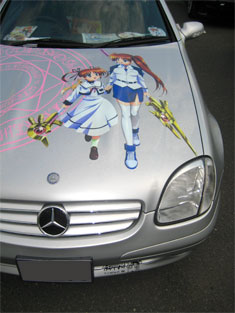
19/09/2008
Yokai Mania! Arcade Attack!
I've been rather busy over the past few weeks rolling out the websites for both Yokai Attack! and Arcade Mania! But both are finished now and getting good feedback.

The launch party for Arcade Mania! will be at Cafe Pause in Ikebukuro on the 27th September. So if you are in Tokyo make sure you come. The author, Brian Ashcraft, has put the invite up on Kotaku, with a link to my site! Nice of him to call me a "wizard". I expect the job offers to start rolling in!
Yokai Attack! site
Arcade Mania! site
09/09/2008
Kaitei Shonen Marine

I am currently editing a book on Japanese pop-culture, and keep stumbling across stuff that dredges up memories from my childhood. Which is odd considering I grew up in Australia.
The latest flashback is to a time I could swim-like-a-fish, using a special oxygen rich chewing gum to help me breathe; and how, with the help of my trusty white dolphin sidekick, I would fight off underwater baddies… I seriously used to dream of being Marine Boy.
I had totally forgotten about this cartoon, and it continues to amaze me how many of the shows I used to watch as kid were from Japan. I sometimes wonder if loving these cartoons when I was young is one of the reasons I am in Tokyo now. I am by no means an anime otaku compared to some people I know, but in the list of my favorite cartoons, there are a lot of anime. Kimba the White Lion, Kum Kum, Battle of the Planets, Speed Racer, Astro Boy, and now the recently remembered Marine Boy, were all big parts of my childhood TV-time. But it was not until I was an adult that I learnt they were Japanese.
I’m not sure why, but somehow I kind of feel I missed out on something. Maybe it’s because I see all these otaku—starting with those about ten years younger than me—who loved anime and manga so much they were inspired to learn Japanese; and I envy them a little. Perhaps in my teens if I had know Battle of the Planets came from Japan, I may have become obsessed with the place earlier. But then I wonder if my eight-year old nephew, who knows Pokemon, Dragon Ball-Z and Naruto are from Japan, will still be into anime when he is older. Or whether he will be like me, and will simply be reminded of them one day.
29/08/2008
Yoda Attack
There's been a bit of a buzz the past few days over Facebook refusing to give a Japanese woman an account because her family name a Jedi to the same it is.
Blogs everywhere have picked up the story and even Lucasfilm posted it on their official blog.
But just who is the Facebook Yoda?
Well I am pleased to say that she is none other than Hiroko Yoda one of the authors of Yokai Attack! Which ironically enough now has a Facebook group.
So join up and rub shoulders with a Jedi.
26/08/2008
Shoko Attack!

Anyone who watches as much Japanese TV as I do is bound to know who Shoko-tan is. She seems to be everywhere at the moment, on countless celebrity panel shows, or performing songs from her new album, or ensuring people have good manners in ads for the Promise finance company. She also has an extremely popular blog.
On one of those many TV shows she appears in, I saw that as a kid she was really keen on Yokai manga. So when I met her the other day (for an upcoming book project I will tell you about eventually) I just had to give her a copy of Yokai Attack! She seemed pretty pleased with it and even exclaimed that it would be good practice for her English.
Here's hoping she puts it on her blog!
